
FAQ
Here you can find the most frequently asked questions, so you can quickly get answers. If you need help, you are always welcome to contact us.

Volunteer Work, Internships, and Visits
Can I volunteer with Land of Hope in Nigeria?
Land of Hope does not run a volunteer programme.
Our Children’s Center is located in the Niger Delta region of Nigeria. Armed militant groups are active throughout the Niger Delta and have carried out multiple attacks on oil and gas infrastructure. The region is considered high risk due to armed robbery, violent crime, and kidnapping. For this reason, we do not accept volunteers at Land of Hope. The area requires armed security 24/7, and if anything were to happen to a volunteer, Land of Hope could be held legally responsible by the Nigerian authorities.
In addition, we prioritise employing local staff to support sustainable development and strengthen the local community.
We strongly encourage everyone to read the official travel advice for Nigeria. At present, most authorities advise against all travel to the Niger Delta region.
Can I volunteer with Land of Hope in Denmark?
When we are in need of volunteers for administrative or support work in Denmark, we announce it on our social media channels and in our newsletter. You are very welcome to follow us on Facebook, Instagram, and LinkedIn to stay updated.
Can I do an internship with Land of Hope in Denmark?
Unfortunately, we do not have the necessary resources to accept interns at this time.
Can my school / organisation / workplace invite Anja Ringgren Lovén to give a talk?
You can book a lecture with Anja through A-speakers, who can also assist with practical matters related to booking and planning.
If you have something else in mind, you are welcome to contact us directly.
Can I visit Land of Hope?
Our Children’s Center, Land of Hope, is located in the Niger Delta region, which is unfortunately a high-risk area due to armed robbery, violent crime, and kidnapping. We strongly recommend consulting the official travel advice for Nigeria. Currently, all travel to the Niger Delta region is discouraged.
In addition, Land of Hope is not an institution – it is a home. It is the children’s only home, and we are a family. We therefore protect our privacy and daily life, just like any other family, and do not accept visitors.

Donations, Regular Support, and the Children
Can I adopt one of your children?
No. Land of Hope is not an adoption agency.
A core part of our work is to reintegrate the children into their local communities and reunite them with their families through regular home visits. The children miss their parents and siblings, and it is our responsibility to help maintain and rebuild these family bonds.
The purpose of the children’s visits back to their communities is to challenge superstition by showing the villages the children’s remarkable transformations – from being rejected, isolated, accused of witchcraft, and nearly tortured to death, to becoming healthy, strong, confident, doing well in school, and having dreams for the future.
This is long-term work. It requires regular home visits for the children and visits from the families to Land of Hope. Family bonds are very strong in African communities, and although superstition may appear to break those bonds, the root causes are poverty and lack of knowledge. These can only be addressed through education, awareness, and a broader understanding of the world.
Can I sponsor one child only?
No. Our vision is a world where no child suffers because of adult superstition. That is why our focus is on creating sustainable change in affected communities. We encourage support for our overall efforts to lift some of the world’s poorest communities out of poverty through education. Education is the most effective way to combat superstition – and to achieve our vision.
How can I become a monthly supporter of Land of Hope?
By supporting Land of Hope with a monthly donation, you help ensure that the children can remain in our care. Your contribution goes towards basic necessities such as daily meals, school fees and transportation, medicine, and hospital visits.
You can become a monthly supporter by selecting “Give monthly” and choosing the amount you wish to give. Payment can be made using most major credit or debit cards through a secure payment system, or via PayPal.
If you wish to change or stop your support, you can contact us at any time.
How do I change or cancel my monthly donation?
If you wish to change the amount you donate or pause or stop your monthly support, please send an email to pia@landofhope.dk. We are deeply grateful for all the support you have given and fully understand if your situation changes.
If you used PayPal, you can find your donation to Land of Hope in your PayPal account and cancel the agreement there.
How do I start a fundraiser for Land of Hope?
If you would like to raise funds for Land of Hope in connection with a birthday, anniversary, wedding, holiday, birth, or simply because our work is close to your heart, you can create your own fundraiser using Land of Hope’s fundraising tool, which is free to use.
You can also encourage family and friends to donate directly via PayPal to anja@landofhope.dk
If you have an idea for a fundraiser – for example at your school, workplace, a local flea market, or another event – please contact tina@landofhope.dk for more information.
Donations of clothes, toys, teddy bears, books, etc. – do you accept them?
We are truly grateful for the overwhelming support we receive and for all offers of clothes, toys, books, and similar items for the children. Unfortunately, shipping packages to Nigeria is very expensive, and we do not have the opportunity to bring items with us ourselves.
We therefore suggest selling the items locally and donating the proceeds to Land of Hope instead. The funds will be used to purchase clothes, food, medicine, toys, books, and more in Nigeria – thereby also supporting the local community. This approach benefits many more people and contributes to a form of sustainable development you can be proud to support.
Donations of medicine or hospital supplies for your children’s hospital?
As a general rule, we do not accept donations of medicine or medical supplies. We are unable to ship them to Nigeria or bring them in our luggage due to strict regulations regarding transport, storage, and handling. We also do not have the facilities to store such items. Even unused medicine from private individuals cannot be accepted, as we do not have the professional capacity to assess whether it has been stored correctly.
If and when we need specific medicines (from hospitals) or medical supplies that can be shipped to Nigeria by container, we will announce this on our social media channels and in our newsletter.
Can I have a receipt for my donation?
A receipt can by requested by e-mailing: pia@landofhope.dk
Can I use Land of Hope’s name and/or logo to raise awareness of your work?
Yes, if used in compliance with Land of Hope’s terms and conditions. Please send an e-mail for detailed information: tina@landofhope.global
You can find logos and photos here

Questions about witch children and accusations

How can people still believe in witchcraft?
In Europe, people once believed in magic as well. Almost all cultures have, at some point in history, been shaped by superstition and the belief in supernatural forces – for example to heal illness or secure a good harvest. For people living before the 18th century, magic was a natural part of everyday life. The world felt mysterious and frightening, and when disasters, illness, or unexplained events occurred, they were explained through supernatural causes.
In the same way, many traditional African belief systems are based on the idea that everything has a supernatural explanation.
Why are children accused of being witches?
Witchcraft accusations have become a way to explain misfortune, death, family breakdown, and illness in poor families and villages. A lack of education limits access to knowledge, and when this is combined with strong cultural beliefs, people search for superstitious explanations.
Children who fall ill with malaria, typhoid, or other common tropical diseases are particularly vulnerable. Children who appear aggressive, withdrawn, stubborn, or who are born with physical disabilities are also at greater risk of being accused of witchcraft.
What happens to a child who is accused of being a witch?
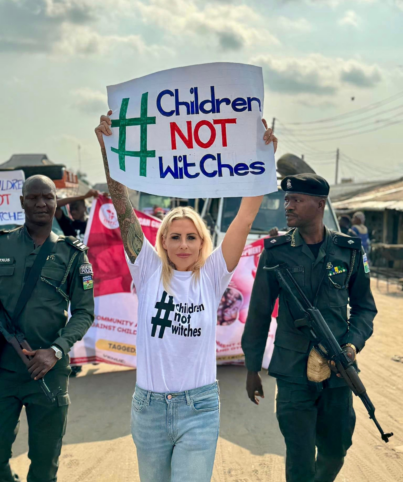
When a child is accused of witchcraft, they are often exposed to both physical and psychological violence. Sometimes this abuse comes from their own family or social circle, and other times from church leaders, so-called healers, or witch doctors.
The accusations do not affect only one child but the entire family, as they eat, sleep, and live together in the same space.
How do you locate a witch child?
Land of Hope works closely with village chiefs in surrounding impoverished communities. It is essential that we have a strong relationship with them and that they trust us. When they do, they contact us when a child is accused of being a witch.
In some cases, village leaders temporarily take the child into their care to protect them until we can arrive. Every year, more than 15,000 children in Nigeria are accused of witchcraft, and sadly we cannot save them all. This is incredibly difficult to accept. But for the children we can reach, we do everything in our power to help them.
How do you rescue witch children?
When we receive information about a child accused of witchcraft, we cannot be sure we will find them. These children are often terrified of adults and survive by running away and hiding.
During a rescue, we calm the child using psychological techniques. Our team members are local and speak the children’s language. We offer them snacks and soft drinks to build trust. If we take a child without reporting it to the police or obtaining consent from a family member, we risk being accused of kidnapping. All documentation must be in order, and this process is often long and inefficient.
If a child is at risk of dying, we take them to hospital. However, in some cases even doctors and nurses believe in witchcraft.
In certain situations, family members do not want our help and resist our intervention, which can escalate into dangerous situations. What may appear simple – removing a child from suffering – is in reality a complex, corrupt, and dangerous process.
How do you help witch children rebuild their lives?
One of Land of Hope’s core values is education. All our children attend school, because knowledge is the key to combating superstition.
We teach our children about their rights. In 1989, the United Nations adopted the UN Convention on the Rights of the Child, which has been ratified by 190 countries worldwide. It guarantees basic rights to all children, regardless of nationality, gender, social status, religion, or culture. Our children need to know this so they understand that what they experienced was not acceptable and that their rights were violated.
But knowing your rights is one thing – how you feel inside is another. That is why Land of Hope’s Child Development team works continuously with the children’s mental health. We provide them with a new sense of belonging and safe adult relationships, allow them to express themselves through music, art, and sport, and support their talents so they experience success. We can never erase the pain of being rejected by their family and village, but we can offer them love, care, and a safe future.
How long can a child stay at Land of Hope?
Land of Hope is not an orphanage – it is a family. We are the children’s legal guardians and have responsibility for them, but we also love them as family.
When the children complete their education and reach adulthood, they decide for themselves where they want to live. Some move away to attend university or begin an apprenticeship, and a natural process of independence follows. We raise all our children to be independent individuals who take responsibility for their own lives.
They are always welcome back at Land of Hope – the place they grew up and call home.
Can anything be done to reduce witchcraft accusations against children?
Belief in witchcraft is deeply rooted in Nigerian culture, and meaningful change will take time. Through Land of Hope’s awareness and education work in Nigeria, we help challenge these harmful beliefs. The more people are educated about the consequences of superstition, the greater the impact.
Nigeria is a very poor country. Around 129 million people live in extreme poverty, and 18.5 million children are not in school. This leaves large parts of the population without access to knowledge, allowing superstition to flourish.
But there is hope – and at Land of Hope, we remain hopeful. We see change happening in small steps, and we know we will reach our goal if we stay committed. You play an important role in this too. You can be the children’s voice and help spread awareness of our work in Nigeria.

Questions about family visits and reunification

Why do you take the children back to visit their families?
In some cases, it is the children’s closest family members who accused them of being witches. In other cases, the accusation comes from a family acquaintance, a religious leader, or a village chief with significant influence over the community. Regardless of who made the accusation, every child has the right to know their family—and the children miss their families deeply, especially their siblings, who are innocent in the situation.
When we bring children back to their villages, we can show the community that the children are healthy, attending school, and clearly not possessed by evil spirits or witchcraft. This helps weaken belief in witchcraft. We never force a child to visit their family if they do not wish to.
Are the children afraid to see their families again?
None of our children are forced to see their families again. It is always their own decision, which is why they usually look forward to the visit. The children often pack a large bag of gifts for their families—clothes, toys, or sweets they have received themselves but saved in order to share them with siblings or parents. This truly shows the strong bond that still exists between the children and their families.
The reunification process is long, carefully controlled, and professionally monitored, often taking several years. The children’s safety is always the highest priority, and no reunification takes place unless it is assessed to be in the child’s best interest—both in the short and long term.
Do any of the children want to move back to live with their families?
Some of our children have rebuilt strong relationships with their families. They spend holidays with them in the villages where they were once accused of being witches.
Destiny is the first of our children to move back to live with his mother in the village. He is now an adult and studies at university.
Many of our children spend their school holidays with their families in their home villages. When they reach an age where it is natural to move out, they usually dream of starting an independent life rather than returning permanently to live with their parents.
Do families ever regret accusing a child of being a witch?
When a child is accused of witchcraft, the belief is often so deeply rooted in the culture that there is no doubt at the time—and therefore no regret. However, when families see the child return for visits over time and notice that the child is healthy, attending school, and living a good life, they no longer believe the child is a witch.

Questions about Hope

How is Hope doing today?
Hope is doing well at Land of Hope. When we rescued Hope in 2016, he was only around two years old. He has therefore lived at Land of Hope for most of his life and lives a very ordinary childhood—going to school and taking part in leisure activities.
Hope has a wonderful personality. He is funny and playful, but also kind and caring towards the other children. He loves to dance and be creative, and he especially enjoys spending time with Anja’s son, David Junior, who is the same age and has grown up with Hope like a brother.
Can Hope speak, and is he deaf?
Hope has been diagnosed as deaf. We do not know whether this is due to the severe malnutrition he experienced as a young child. We have tried hearing aids, but Hope has chosen not to use them and has instead developed his own way of expressing himself.
He communicates through sounds and sign language and does not speak in the same way as other children. Despite this, he is a joyful boy with strong self-confidence and a great desire to communicate.
How is Hope’s mother doing?
Hope’s mother was only 15 years old when she gave birth to him. At the time, his father was around 50 years old and one of the village leaders. Sadly, sexual abuse, exploitation, and child labour are part of her story, and she was eventually sent away to Lagos. For security reasons, we cannot share further details.
Today, we have re-established contact with Hope’s mother, and she regularly visits Hope at Land of Hope. Their relationship is developing positively, but Hope will continue to live at Land of Hope.
Hope’s mother also has another son, Daniel, who is Hope’s younger brother, and we hope the two will one day meet. In fact, Hope’s real name is Steven—but his mother also likes the name Hope.
Questions about Anja

What made Anja start Land of Hope?
Life in Nigeria is very different from the life Anja Ringgren Lovén comes from, but hardship and adversity were not unfamiliar to her. She grew up in Frederikshavn in a small terraced house with her mother, older sister, and twin sister. Her mother passed away when Anja was young, and her father struggled with alcoholism. As a young woman, Anja herself battled depression, anxiety, and anorexia.
In her twenties, Anja watched an English documentary about children accused of witchcraft in Nigeria. She saw how children were tortured, buried alive, and killed because of these accusations. It ignited a deep anger—particularly towards world leaders who were doing nothing to stop it. That anger reawakened a childhood dream of Africa, which she decided to pursue—first in Malawi and later in Tanzania as a humanitarian worker.
After several years, she founded her own aid organisation, which later became Land of Hope. Many people wonder what made Anja leave her safe life in Denmark to work in one of the most dangerous regions of Nigeria. To that, she usually answers:
“I simply followed my heart.”
Does Anja live in Nigeria?
Anja Ringgren Lovén lives alternately at the children’s centre Land of Hope in Nigeria and in Denmark with her son, David Junior. Anja and her husband, David, decided that their son should attend school in Denmark, as schools in Nigeria are not considered safe for him. The risk of kidnapping is too high, as criminal groups seek access to the funds that finance Land of Hope.
It is difficult for both Anja and David Junior to say goodbye so often. Fortunately, school and sports activities fill much of everyday life in Denmark, and when Anja is there, she focuses on fundraising and giving lectures. They stay in close contact with David Junior’s father and all the children at Land of Hope through online calls and videos they share with each other.
Is it dangerous for Anja to be in Nigeria?
Nigeria is one of the most dangerous countries in the world. The state where Land of Hope is located is among the six most dangerous states in Nigeria to travel to, due to kidnapping, armed groups, and widespread crime. For this reason, Anja can never disclose when she enters or leaves Nigeria or when she is in the country. She is protected by security guards around the clock.
Nigeria’s ongoing economic crisis has made the situation even more dangerous. Extreme poverty has left many people struggling with hunger, increasing desperation — and with it, criminal activity. Extensive preparation is required before Anja can travel to Nigeria with David Junior.
Does Anja’s Nigerian husband want to move to Denmark?
Anja’s husband, David, does not have a desire to move to Denmark. His goal is to help make the world a better place in Nigeria, and he is actively involved in the country’s development — both politically and through his work as a lawyer.
The children at Land of Hope, on the other hand, dream of visiting Denmark one day to experience snow, which Anja has shown them in photos.
What does Anja value most about her work?
For Anja, the greatest joy in her work at Land of Hope is witnessing the children’s development—seeing them transform from rejected and frightened children on the streets into strong, independent individuals who pursue education, attend university, and create a bright future for themselves.
Get to know us
Book
In Anja’s book, “Mother of the Witch Children,” she shares her life story and explains why she decided to fight for Africa’s witch children. Here, you get the full story of how Land of Hope came into being. The book is only available in Danish and Polish.
Documentary
There is a brand-new documentary about Land of Hope on the streaming service Max.
- “The One With Hope” on Max (HBO)
Keynotes & events
Anja regularly gives speeches around the world and can also be booked for talks. She is an experienced speaker and is skilled at discussing her work at Land of Hope – and also inspires you to follow your heart.
Start a Fundraiser
Do you want to help? Through Land of Hope’s website, you can start your own fundraiser for the children at Land of Hope. Once you’ve set it up, you can print a poster with a QR code. This makes it easy for others to support. It’s free for you to create the fundraiser using Land of Hope’s tool.