Land of Hope needs to be self-sufficient

Land of Hope needs to be self-sufficient
Land of Hope has taken another important step towards its goal of becoming self-sufficient. A professionally run cattle farm has now been established, starting with 42 cows brought in from Kaduna in northern Nigeria. The cattle are now part of Land of Hope’s overall agricultural effort.
The farm was set up with external professional support, and animal welfare is a top priority. The cows are kept in fenced areas and are regularly checked by a veterinarian to ensure healthy and safe conditions.
Part of a long-term plan
“We have always dreamed of having as many animals as possible at Land of Hope,” says Anja, who received the cows as a Christmas gift from her husband, David Emmanuel Umem.
“We already have large water tanks for fish farming and a poultry farm with thousands of chickens and chicks. David says his mission is for us to one day have 50,000 cows. He dreams big – and he always gives 100 percent to reaching his goals.”
The vision of self-sufficiency has long been a cornerstone of Land of Hope’s work. In a country affected by economic instability, inflation and rising food prices, the ability to produce food independently is crucial. It strengthens the organisation and helps secure stable living conditions for the children – even during times of crisis.
But the farm does more than provide food.
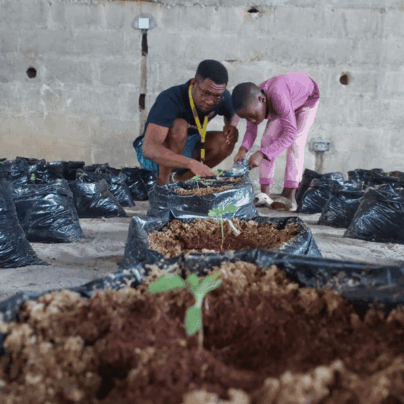
It also serves as a learning space. The children take part in daily activities and gain hands-on knowledge about farming, animal care and responsibility – skills that can play an important role in their future lives.
From vegetables to animal production
Land of Hope’s self-sufficiency rests on several key pillars:
1. Vegetable farming
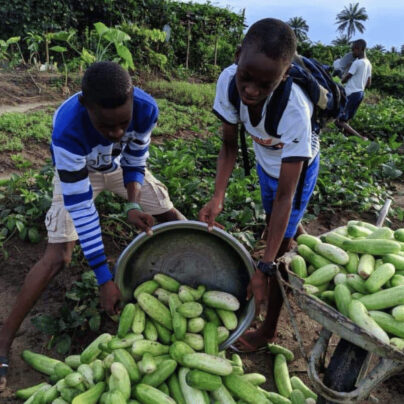
Vegetables such as cucumbers, yams, carrots and tomatoes are grown on Land of Hope’s own land and on rented fields outside the centre’s walls. The produce is used directly in daily meals. At the same time, the children learn how to grow and care for crops.
2. Animal farming
In addition to cattle, Land of Hope has invested in animal production for several years. Fish farming in water tanks and a poultry farm with more than a thousand chickens and chicks are already well-established parts of daily operations.
Production has grown to a level where surplus food can be sold at local markets, providing additional income for the centre.
3. Clean drinking water
Access to clean water is essential. Land of Hope has its own water system, ensuring a stable supply of safe drinking water for both children and staff.
4. Healthcare and medicine
As part of the self-sufficiency strategy, Land of Hope has built its own hospital with an operating room, waiting area and space for up to 20 patients. Today, it functions as a clinic where in-house nurses can treat and admit children when they fall ill. In the long term, the ambition is also to offer basic healthcare to poor villagers in nearby communities.
Your support has a long-term impact
Seen from the outside, Land of Hope is far more than a children’s centre. It is a small community where food production, clean water, healthcare and learning are closely connected. The experience gained through the journey towards self-sufficiency has the potential to inspire similar initiatives in other vulnerable areas – with self-reliance as a key to stability and survival.
When you support Land of Hope, donations are invested in solutions that promote sustainable development and create lasting value – for the children at the centre and for the surrounding community. The cattle farm is just one concrete example of how support is turned into action and long-term security.